
Product / Programme Alignment & Gap Analysis
See what a new requirement means for the way you already work.
A new certification, buyer requirement, licence, contract, regulation, or export market should not mean starting compliance from scratch.
Porticus compares the programme you already run with the obligation you need to meet. See what already maps, what is partial, what is missing, and what to update or create next.

The problem
Most gap assessments begin by forgetting how your business already operates.
A new certification, buyer requirement, licence, contract, regulation, or export market arrives. The usual response is to start with a template, a consultant checklist, and a blank project plan. That treats the business as if it has no existing programme. It overlooks the controls, procedures, evidence, and practical knowledge already in place.
The result is duplicated work, slow remediation, and a gap report that describes the standard but does not help the business get there.
Porticus starts with the programme you already run, then shows what is already working and helps you close what is not.
Start with your real programme
Start with the QMS you already run.
Then add the target requirement: a certification, regulation, buyer code, licence condition, supplier requirement, contract, or export-market obligation.
Porticus uses AI to compare the two while preserving the source material and reasoning behind the result. It then helps turn the findings into the documents, requirements, and actions needed to close the gaps.
See the real gap
Four answers before you commit the work.
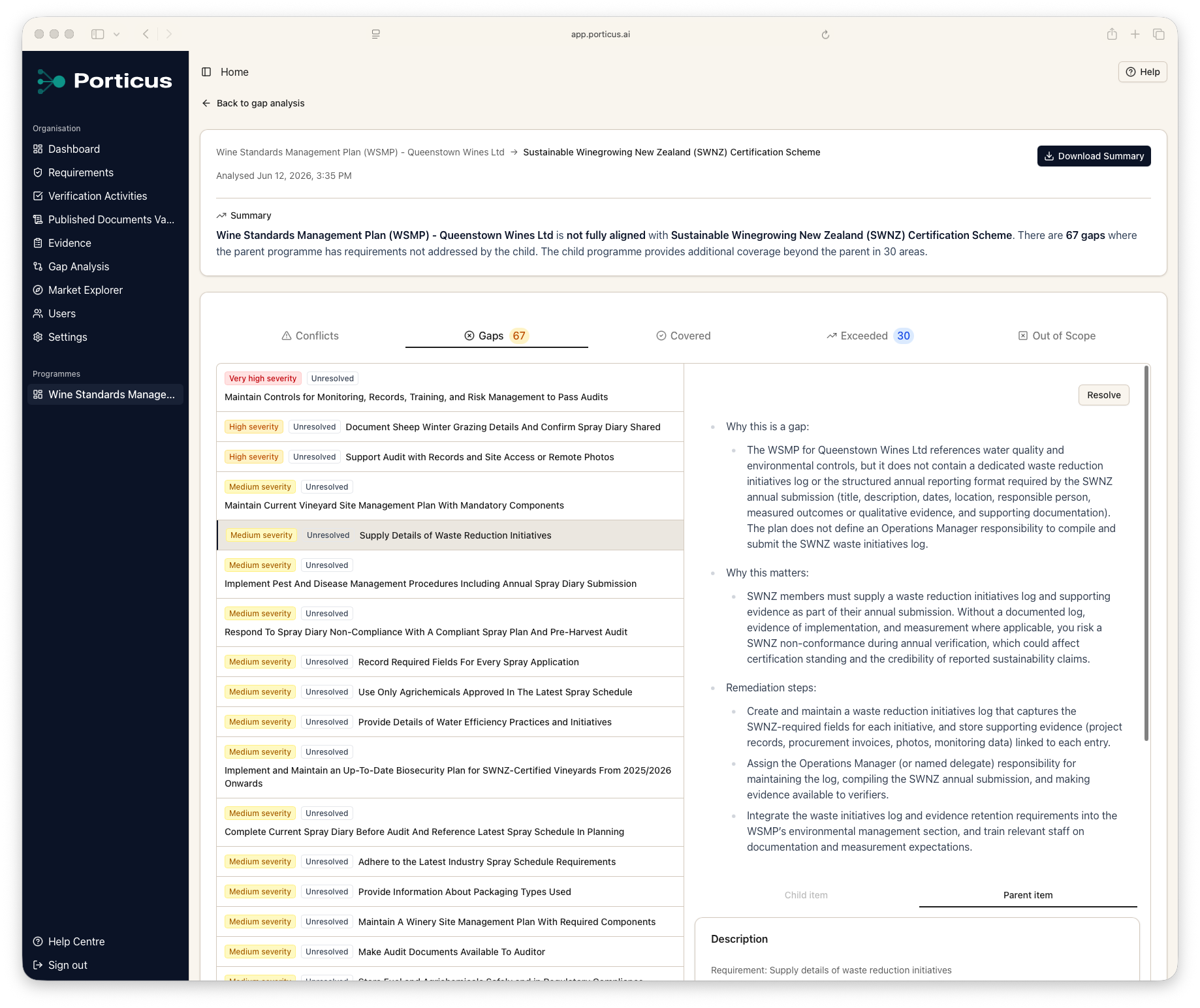
Covered
What your programme already addresses, including the control, procedure, or evidence that supports the conclusion.
Partial
What exists but needs stronger detail, ownership, verification, frequency, evidence, or documentation.
Missing or conflicting
What needs to be added or changed before the target requirement is met. Prioritise the work that gets the business up to spec first.
Reusable work and next steps
Where an existing control, procedure, or evidence item can credibly support the new requirement, and the practical sequence for closing what remains.
Ask why, not just what
A gap report you can interrogate.
A colour-coded result is not enough. Your team needs to know why something is covered, partial, missing, or conflicting. Porticus grounds the answer in the business's current QMS and the target requirement, so the team can follow the logic rather than accept a black-box result.
Interrogate the gap report
What in our programme already covers this retailer hygiene requirement?
Identify the controls and procedures that map to the retailer hygiene requirement and review the referenced evidence in the mapping review.
Source: Retail Hygiene Mapping Review v1.4
Answers are grounded in your current QMS. Your team remains responsible for review and action.
Close the gaps
Move from a gap report to an updated programme.
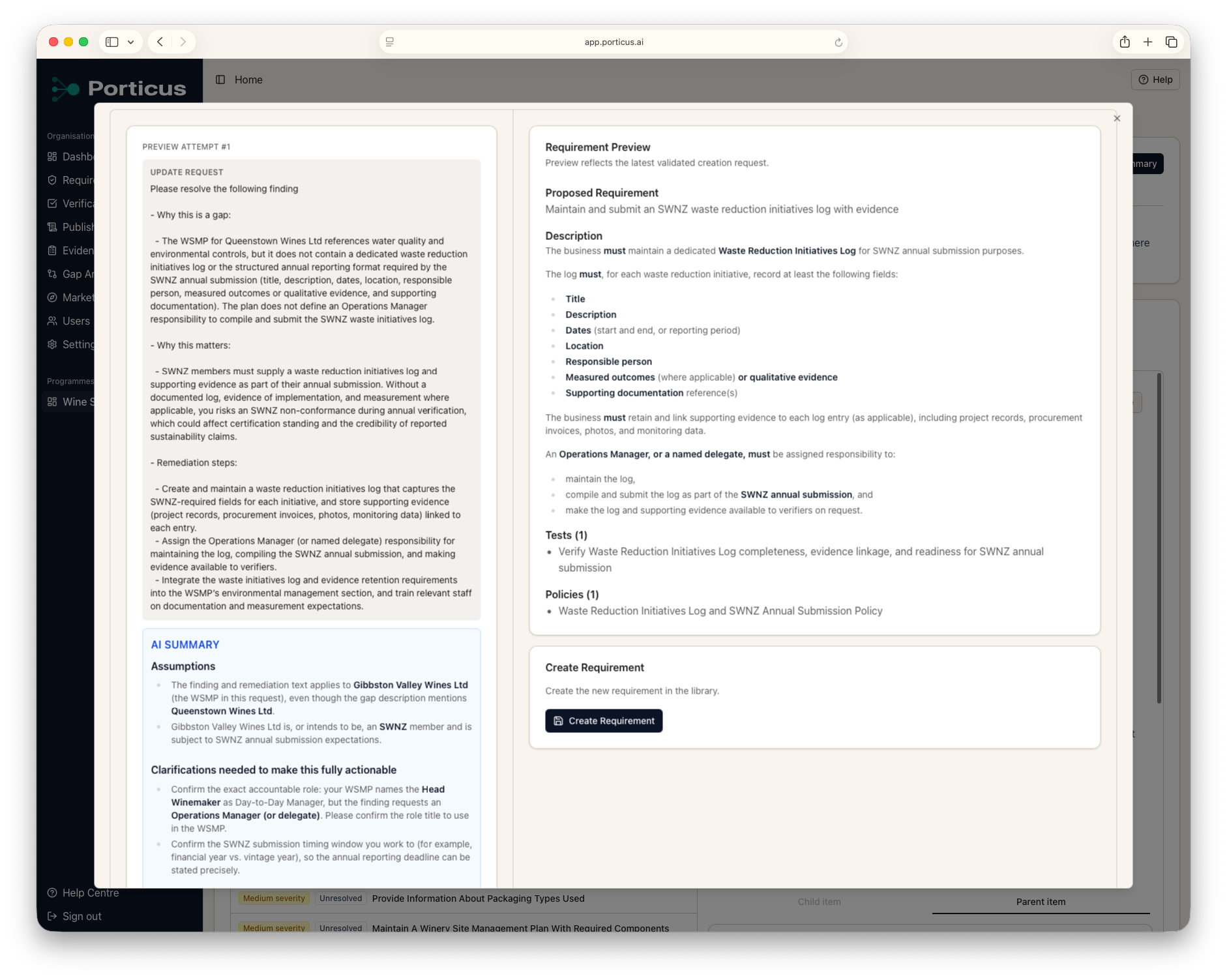
Update published procedures, policies, controls, and requirements where you are close but not yet aligned
Keep each update grounded in the way you operate, rather than applying generic template language
Create new documents and requirements where a genuine gap exists
Connect new and updated work to the evidence, owners, actions, and related obligations it affects
Prioritise remediation across people, sites, and programmes
Explain the work, risk, and resource demand to leadership and finance
Your team, consultant, or specialist reviews and approves the changes. Porticus makes the path from gap to compliant programme faster and specific to the business.
Example
A retailer requirement without a full restart.
A food producer has an established HACCP plan, supplier controls, monitoring records, and site procedures. A retailer introduces a new supplier code. Porticus compares the code with the programme already in place. It shows which controls and evidence already support the code, where coverage needs strengthening, and what is genuinely new. It then helps create or update the procedures, requirements, and actions needed to close the real gaps. The producer and its consultant review the changes, ask questions of the source materials, and focus on the work that brings the programme up to spec.
The outcome